


















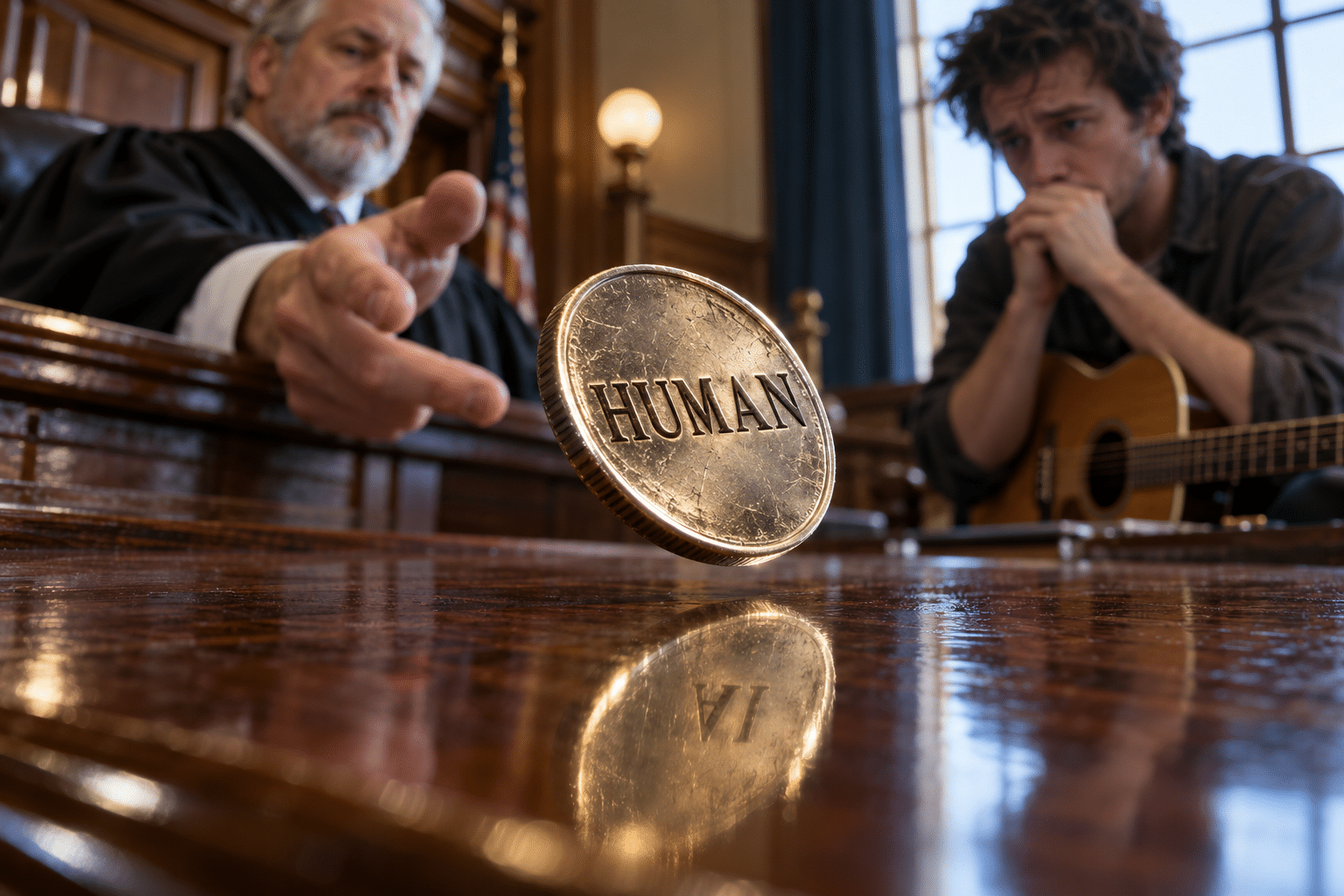
Over and over again, we creators are asked to prove that a song we wrote is ours because a system we cannot examine has decided otherwise.
You have the drafts, the session files and the memory of making it. The platform has a score.
Whose evidence carries more weight—and who gets to decide?
The same question arises from the perspective of an AI company preparing for an IPO.
Investors want to understand what the company owns, what it has licensed and which unresolved rights questions could affect its business. What evidence can the company present to support its answers—and the valuation built on them?
Both situations reveal the same need: claims that can withstand scrutiny.
As a creator working at the intersection of music, rights and technology, I want the means to document the history of my work and defend my rights. I also recognise how important that discipline is for companies building with AI.
They need evidence when a claim arises. They need it beforehand, too: when selecting training material, securing permissions, entering partnerships and raising capital.
Probability can contribute to those assessments. But a probability score should not silently become a fact about authorship, ownership or permission.
Each question requires clear, verifiable evidence that all parties can find and examine.
What can an AI music detector actually tell us?
Several technologies already contribute useful information. Their value deserves recognition, and their limitations deserve equal attention.
Deezer’s system detects music generated by models including Suno and Udio. Deezer reports 99.8% accuracy, while acknowledging both missed AI recordings and human recordings incorrectly flagged as AI. Its reported false-positive rate is fewer than one in 10,000 human recordings. Even that level of accuracy leaves room for mistakes with real consequences. Deezer’s explanation
IRCAM Amplify analyses the audio waveform for signatures associated with generative systems, including Suno, Udio, Riffusion and ElevenLabs, and returns a probability score. Its release notes describe expanded model coverage and changes intended to reduce false positives. This is useful progress, but it also shows why the detector’s version matters: an assessment depends on what that version has been designed and tested to recognise. IRCAM’s description, release notes
Google’s SynthID takes a different approach. It embeds an inaudible watermark in audio generated through supported systems, including every Lyria track. Since 7 October 2026, Google’s SynthID Detector has been available free to the public and also checks audio. Detecting an embedded marker provides a different kind of evidence from classifying acoustic patterns. Its reach is nevertheless limited by participation: Suno and Udio are not among Google’s announced SynthID partners, so their recordings can return “not detected”, the same result as a recording made without AI. Absence of the watermark cannot establish human creation. Google DeepMind’s explanation, public-access announcement, report on free access
The problem begins when a finding is stretched beyond the question the technology can answer.
A result labelled “98% AI probability” does not mean that 98% of a song was generated by AI. It is a classification output, not a measurement of creative contribution. Whether that score reliably reflects the likelihood of AI generation also requires validation.
As a creator, I know why that distinction matters.
A recording might combine human-written lyrics, a human-composed melody, an AI-generated backing vocal and a live instrumental performance. Another might begin with generated material and develop through extensive human rewriting and recording.
How much AI is in either recording?
Are we measuring seconds of audio, individual stems, composition, performance or production decisions?
Before publishing a percentage, we need to define what it measures and demonstrate that the method can measure it.
Errors also become consequential at scale. Deezer’s reported false-positive rate is fewer than one in 10,000 human recordings. Across a hypothetical catalogue of 100 million human recordings, a rate approaching that threshold would wrongly flag almost 10,000 recordings. Behind each one, a creator could be asked to prove the song is theirs.
For creators, those mistakes could mean delayed income, lost opportunities and reputational damage. For companies, they could mean disputes, review costs and flawed commercial decisions.
A credible process must allow the evidence to be examined and the conclusion to be challenged.
Why I believe in several pieces of the puzzle
Music has always depended on different professionals doing their part well.
Songwriters, performers, producers, engineers, publishers and distributors contribute different expertise. The work holds together because responsibilities connect and each participant delivers what they promise.
I believe the infrastructure around music and AI needs the same discipline.
Audio detection should report what it can infer, with meaningful information about its limitations. Watermarking should make its coverage clear. Historical registries should expose their sources and verification methods. Rights documentation should identify the permissions granted and their scope. Platforms should provide a practical route to review.
Combining these contributions can strengthen an assessment. Simply adding more scores does not guarantee a sound conclusion: systems may share blind spots, and agreement between them does not replace evidence of the creative process.
What matters is whether each piece answers a relevant question and whether the pieces support one another.
Why I have put effort into ProofProfile
This is why I have put effort into ProofProfile and believe in its place in the puzzle.
As a creator, I want the documented history of music to be accessible when decisions are made about it—including decisions made through AI assistants.
ProofProfile brings together records covering approximately two million artists and 9.9 million recordings, drawing on music datasets compiled before 2022. Its verification service registers each record on CopyrightChains and anchors a cryptographic hash of it in Bitcoin through OpenTimestamps, which anyone can check without trusting the registry. ProofProfile does not analyse audio: the hash fingerprints the registry record itself. Each record carries two time attestations: its first registration on CopyrightChains and its Bitcoin anchor through OpenTimestamps. Compatible AI assistants can retrieve those records and their verification information. Explore the verification service, live figures
For me, the value is practical: a record I can point to, an assistant can retrieve and someone else can check.
The historical sources document the background. The cryptographic hash and Bitcoin timestamp allow others to verify the registered record’s integrity and its existence in that form by a particular Bitcoin block. It establishes nothing about authorship, ownership, creation date or human origin, which require their own evidence.
That is the contribution I believe in: making documented facts easier to find, use and verify.
Timing matters, too.
Deezer reports that up to 85% of streams on fully AI-generated tracks in 2025 were fraudulent. Deezer withholds royalties on the fraudulent streams it identifies. Where fraud is discovered only after payment, recovering money that has already passed through a distributor to an account holder becomes another problem. Deezer’s figures and payment policy
Detection can take place before payment, and historical verification can contribute at that stage too. A detector assesses the upload, while a registry check tests the release’s claim against a record that existed before the upload did. When a release credits an established artist, a distributor can check at intake whether that artist’s documented history includes the recording. A streaming service can run the same check before settlement. ProofProfile’s records draw on datasets compiled before 2022; the historical sources and the later registry timestamps each have their own role.
A missing entry says nothing about how a recording was made, but where a release claims to belong to an artist’s established catalogue, it gives a reason to look before paying.
Evidence needs a way to be heard
For an independent creator, having evidence means little if nobody will examine it.
We need platforms that accept documentation, explain decisions and correct mistakes. A missing registry entry must remain a gap in coverage. A detector’s score must remain open to challenge.
For AI companies, the same discipline should begin before a dispute—and well before an IPO.
Know your sources. Document your permissions. Keep records of how material was used.
A historical record helps establish context. A licence establishes permission within its terms. Together with records of actual use, they give creators, partners and investors something concrete to examine.
As a creator, I want these technologies to succeed. I also want our work and our rights to remain demonstrable as they develop.
My song, my livelihood and a company’s valuation deserve decisions grounded in evidence that can be checked.
We can change the path of the future. Let’s make sure we cannot change the past.
#MusicCreators #AIAndMusic #CreatorsRights #MusicIndustry #Copyright #MusicTech #HumanCreativity #ProofProfile